

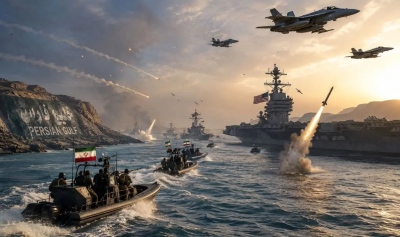
The Middle East, to many Western observers, resembles Long Covid syndrome. One moment you believe the crisis has passed, that the worst is behind us, and the next you find yourself once again facing the exact same problems: conflicts, instability, insecurity, and uncertainty. In psychology, this state could be described as "déjà vu"—the feeling that you are incessantly reliving the same experiences. For those residing in the most turbulent regions of the Middle East, this reality is far harsher. As missiles fall once again today in the Persian Gulf, the question is not only which chapter of the region's long history of conflicts is repeating itself, but also what is bound to follow, notes Modern Diplomacy in its analysis.
In 2016, Donald Trump, as a candidate for president of the United States, stated that "the US would be in a better position if it had not gotten involved at all with the Middle East over the previous 15 years." This view, according to the author and former State Department official under the presidency of George W. Bush, was not unfounded. The overthrow of Saddam Hussein in 2003 opened, as he notes, "Pandora's box," the consequences of which continue to affect the region to this day. Ironically, he recalls that George W. Bush himself had been elected with the commitment to halt "nation building" policies—meaning American efforts to reconstruct states abroad.
September 11 changed everything
Everything, however, changed after the terrorist attacks of September 11, 2001. Seeking an answer to the question "Why did they attack us?", George W. Bush concluded that the maintenance of authoritarian regimes in the Middle East could no longer guarantee the security of the United States. As he had stated at the time: "Sixty years of Western tolerance of lack of freedom in the Middle East did nothing to make us safe, because stability cannot be purchased at the expense of liberty." The author considers this diagnosis to have been largely correct. However, he reminds us that the United States itself had contributed for decades to supporting authoritarian regimes in the region. He refers, among other things, to the overthrow of the democratically elected government in Syria in 1949, as well as to Operation Ajax in 1953, which led to the ousting of the democratically elected prime minister of Iran and the restoration of the Shah to power.
The moment George W. Bush is informed of the September 11 attacks.
The vision of the "Freedom Agenda"
Following September 11, Bush launched the so-called "Freedom Agenda," combining it with the Global War on Terrorism. The new strategy dictated that the United States would abandon the policy of supporting dictators and authoritarian leaders and would instead invest in the promotion of democracy throughout the Middle East. The theory, influenced by Natan Sharansky's book "The Case for Democracy," argued that democracies are inherently more peaceful, whereas authoritarian regimes are more aggressive. Consequently, more democracy in the Middle East would mean fewer chances for new terrorist attacks like those of September 11.
The result was the exact opposite
Twenty-three years later, the assessment is deeply disappointing. The author argues that the political character of the Middle East remains almost identical to the one George W. Bush inherited, while in several cases, the situation has worsened. In Libya, Muammar Qaddafi is gone from power, but the country has essentially disintegrated. In Syria, the Assad dynasty collapsed, but it was replaced by a new, equally unstable regime. In Egypt, many citizens now feel nostalgic for the period of Hosni Mubarak, while Donald Trump had characterized the country's current president as his "favorite dictator." At the same time, Yemen continues to experience one of the largest humanitarian crises globally, Lebanon remains in a deep political and economic crisis, while Tunisia records a return to authoritarianism.
Enormous cost, minimal result
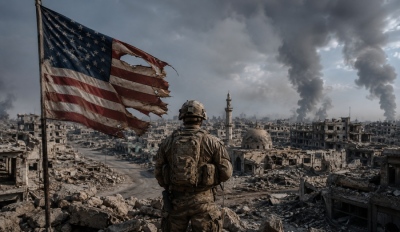
According to the columnist, the two largest American military interventions after September 11, in Iraq and Afghanistan, carried an immense economic, political, and strategic cost. The total cost to American taxpayers is currently estimated between 4 and 6 trillion dollars, without factoring in future expenditures for veteran care. Meanwhile, the human casualties have been immense for all parties involved.
Iran shows that history repeats itself
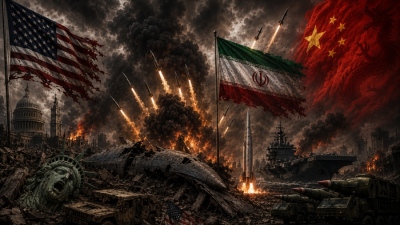
Prompted by the new crisis in the Straits of Hormuz and the confrontation between Washington and Tehran, the author wonders whether the peoples of the Middle East—and Western economies—would ultimately have benefited more if the American military interventions of the last two decades had never taken place. This question deserves a serious debate. The new crisis in the Persian Gulf resembles a film that the world has already watched many times and which, to this day, has never had a different or happy ending.
www.bankingnews.gr




Σχόλια αναγνωστών